Showing posts with label paas. Show all posts

Tuesday, May 19, 2009

Cloud Computing Taxonomy at Interop Las Vegas, May 2009

If you have read my blog in the past, you will know that my schtick in covering the Cloud Computing and SaaS space is taxonomies. I have created a number of them, and have been an invited speaker to talk about them. Here are a couple of examples from the past:

Peter at Enterprise Cloud Summit

Yesterday, I spoke on the topic of taxonomies at Enterprise Cloud Summit, a conference within a conference at Interop Las Vegas. I was impressed by the turnout despite the economy – Alistair Croll did a great job putting together a great speaker list which in turn drove a lot of traffic into the sessions. My session went early on the first day, so it was my job to setup the landscape of the Cloud Computing industry. The taxonomy was perfect for that task.
Cloud Summit

May 2009 Cloud Computing Taxonomy

In support of my speaking at Interop, I have updated my Cloud Computing taxonomy. I have restructured the buckets a bit since the last time, and of course I have added some new vendors that have come on the scene. I have also removed a couple of solutions that have since exited (or have appeared to exit) the market – Coghead, Skemma, and Mule OnDemand. Cassatt, while not done yet, is marked with an asterisk to indicate its current status.
A few additional notes about the construction of this map:
  • There is a size limit, so not every vendor in every bucket can be covered. I include what I think are the major players, and include others as space allows
  • Some vendors could fit in multiple buckets, but generally I place the vendor in their main area expertise only
  • There are several categoris – hardware, virtualization, system integrators – that I don’t include at all. I find that they are spaces that deserve entire maps on their own.
  • News rolls in every day – AT&T just announced a Cloud storage solution. Please add a comment if you see a vendor that is missing that you feel should be included.
  • Some of these “vendors” are not actually vendors – some are open source solutions.
And a final word before presenting the map – I always recommend a different source for those who want to see a more exhaustive list of vendors in this space. Jeff Kaplan of THINKStrategies has created a SaaS Showplace which is an exhaustive catalog of vendors.
Cloud Taxonomy April 2009_final
(Click on the image for a larger version)

Descriptions of the Buckets:

To provide some insight into what each bucket means, listed below are descriptions.

Infrastructure

  • Public Clouds – the poster children of Cloud Computing. These vendors offer computers as a service. If you need 50 computers in 15 minutes, these guys will take care of that. Differentiators include the provisioning model (virtualized instances vs. actual machines) and the host OS versions that are supported.
  • Private Clouds – these solutions help enterprises build private clouds within the firewall. If privacy and control is a big concern, or you want to increase utilization in an existing data center, a private cloud may be what you want.
  • Compute and Data Grids – while these solutions are also useful outside of a cloud, they can play an important role for applications that are deployed within a cloud. The key difference with Cloud applications from traditional on-premise applications is in how they must scale. With an on-premise application, you can scale vertically when the load gets too high – by buying a bigger machine. In the cloud, applications must scale horizontally – by adding more machines in a cluster. Compute and Data Grid products can help achieve horizontal scalability.
  • Virtualization and Appliances – when deploying OS stacks to public and private clouds, you will find it helpful to have a library of virtualized OS images. The vendors in these buckets will help in this area. Also, depending on the cloud being used, any number of Virtualization technologies will be used.

Platform

  • Business User Platforms – these platforms are cloud based application development environments. The focus of these platforms are on non-programmers as the application developers. To make this happen, these platforms offer rich visual tools to enable the developers to define data models and application logic. The differentiators for these platforms are their features – which is important to investigate during software selection as there is no coding allowed, so developers cannot code around feature outages.
  • Developer Platforms – these platforms are cloud based application development environments that support custom coding. Developers can build highly customized applications with these platforms, without having to worry about scalability, OS configuration, load balancing, operations, etc as they would with a public cloud offering. The differentiators for these platforms include the supported programming languages (Java, python, custom, etc), and data storage capabilities (RDMBS, key-value stores, etc).

Services

  • Storage – these vendors offer hosted storage that are API accessible. Meaning, any application can get/set objects into these Cloud storage solutions. The solutions vary in the supported data access models – key-value stores, file stores, etc.
  • Integration – solutions that provide integration facilities between multiple Cloud applications, or Cloud applications with on-premise applications. Major features offered are: messaging queues, business process modeling (BPM), and application adapters (like NetSuite adapter, SAP adapter).
  • Metering and Billing – building your own billing and invoicing system is highly discouraged. This is a great operation to outsource to a specialist. These vendors offer expertise in how to structure billing plans, plus all of the back office capabilities behind invoicing and collection. By outsourcing to one of these PCI compliant vendors, you will reduce the level of compliance your Cloud application will need to attain.
  • Security – The Cloud infrastructure and platform vendors must provide security, and so a base level can be assumed. But for value-add features, like application authorization features, encryption, and Single Sign On capabilities across multiple applications – look to these vendors.
  • Fabric Management – this is a space that evolves quickly, so you will need to keep up to date on new developments with these vendors. Generally, these vendors help you manage and deploy your application in the Cloud. This varies from features that allow you to design a virtual data center in a cloud, to auto-scaling an application when load increases, to monitoring Cloud servers to restart them if they fail.

Applications

  • SaaS – these vendors represent the ultimate end-game to all of this – Cloud based applications. There are thousands of them, and are traditionally known as Software as a Service (SaaS) applications. SaaS applications are available over the internet, are quick to provision a new account, are offered in a pay-as-you-go model, and allow some level of customization. NetSuite, Salesforce.com, Taleo, Concur, Workday and many others have established the space as a viable way to deliver software.

Vendor Links

Below are links to each of the vendors and solution depicted above.

Please Comment

I have found some of the vendors above via comments placed on earlier versions of the map. If you know of a solution that you feel should be included, please post a comment on the blog. I can’t promise I will add it (the map is size limited), but I would like to see other solutions. Thank you!

Monday, September 15, 2008

Comparing Cloud Computing Mindshare Levels Between the U.S., Europe, and Asia

Would you believe that the U.S. has 4 times more people interested in cloud computing than Europe? How about 5 times more people so interested than Asia? It is impossible to derive irrefutable evidence to validate those statements, but this blog entry offers one concrete data source that indicates those statements are true.

There have been various studies on cloud adoption and mindshare. For a young industry, it is an important metric to understand. Just this week, Chris Marino started a cloud adoption topic thread on the Cloud Google Group. He cited the Pew's report on American adoption of cloud applications.

This blog entry provides more data for that discussion. However, it focuses not on the adoption rate within the U.S., but the relative interest in cloud computing topics across continents. It uses traffic data from my blog as the input into the analysis.

Aggressive Extrapolation

Just to give you fair warning, I am about to draw sizable conclusions from a single source of data. This data source, traffic to my blog, cannot be proven to be a meaningful measurement. But I am writing this blog entry anyway because I think it is an interesting topic and the data might be meaningful. Also, I find there is an absence of information on this topic out on the net, so I hope this is a good starting point for other studies.

Here are a couple of assumptions I am making during this analysis:

  • Given that blog access is location independent, there is an equal opportunity across regions for any cloud computing enthusiast to read my cloud blog entries
  • Given equal opportunity, the readership of my cloud blog entries roughly matches interest level in each region for the topic of cloud computing in general

You could certainly argue that my blog does not generate enough traffic to be a significant measure. You could also argue that the level of blog readership in general isn't consistent across the regions.

You could also probably find about ten other reasons why this study is not conclusive. Once again, I hope this is a starting point for others to contribute meaningful data, and so this blog entry will be published despite the possible objections.

The Raw Data:  Blog Readership Numbers

I will first introduce the raw visitor numbers of a handful of blog entries, as captured by Google Analytics. Later sections will explain the data and what to look for in these numbers.

Blog Entry Cat
gory
Visits U.S. % Europe % Asia %
Cloud Taxonomy V2 Cloud 1631 67 17 13
Cloud Taxonomy V1 Cloud 1172 63 20 15
SaaS Taxonomy SaaS 207 54 18 26
SaaS for IBM, ORCL... SaaS 191 40 32 25
SaaS Contract Analysis SaaS 196 69 22 8
Control 1 Ctrl 131 51 27 16
Control 2 Ctrl 363 53 24 21


A few words on the data collection gathered from Google Analytics:

  • These numbers reflect visits between July 1, 2008 and September 14th 2008
  • Some of the entries were not available during the entire collection period.
  • They do not include RSS readers, as my feed exposes the entire entry
  • Some of the older entries started life on a different blog system before being migrated to this blogspot account in May. Some clicks may have gone to the older blog system for those entries and were not captured.
  • Visits are unique visitors, which each may account for one or more pageviews
  • The numbers don't add up to 100% due to hits coming from places outside the three regions

Primary Evidence: Cloud Computing Visual Map Entry

The primary piece of evidence, and the one from which I drew the main conclusions, is an entry made on September 8th 2008. It is titled "Cloud Taxonomy V2" in the table above. The blog entry contains the second version of  a vendor map I have drawn that visualizes the cloud computing industry. I pick this entry as the primary evidence for the following reasons:

  • It is very recent, and therefore very "clean" in terms of tracking actual human users reading the entry
  • It is an entry with general appeal - it covers the industry as a whole. It therefore should represent a broad measurement of interest.
  • It has enough visitors (1631) to make for a good sample size

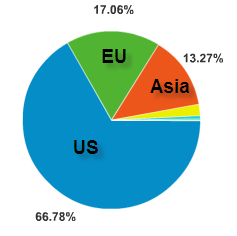
The evidence reveals the following distribution:

image

It is from this data that the main conclusions are drawn:

  • U.S. interest in the topic of cloud computing is 4 times greater than in Europe
  • U.S. interest in the topic of cloud computing is 5 times greater than in Asia

Look also at the numbers associated with the blog entry listed as "Cloud Taxonomy V1". That was the first version, released in May of this year. It is comforting to see that the V1 numbers roughly match the V2 numbers.

What About the SaaS Numbers?

You will notice that the SaaS themed blog enties don't carry the same distribution as the cloud entries. This is odd, as SaaS is a subset of cloud computing (see the referenced taxonomy diagram if you want to see why).

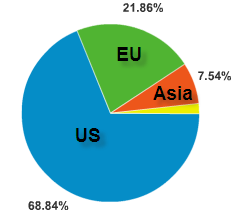
Specifically, look at the first two SaaS blog entries, found here and here. See how the U.S. has a lower share of the readership than with the cloud taxonomy entries:

image

One fabricated explanation - its about early adopters?

  • The U.S. contains a higher percentage of early adopters (hypothesis)
  • The overall cloud computing industry is still quite young , and dominated by early adopters. Therefore, the U.S. has a greater share of the readership of the general cloud taxonomy entries.
  • SaaS is further along in adoption than the overall cloud computing industry. Therefore, you will see more balance in the interest levels.

Now look at the third SaaS entry - the one titled SaaS Contract Analysis. This one actually shows a higher distribution for the U.S. relative to the cloud taxonomy entries. Why?

image

Once again, a totally fabricated explanation - does this show Adoption as opposed to Mindshare?

  • The SaaS Contract blog entry contains an analysis of SaaS contract terms, and suggested terms to avoid as a customer.
  • This is not an entry for future thinkers or those just kicking the tires. This entry is primarily useful for those actually implementing SaaS and who need to review contracts with vendors. Perhaps this may show actual adoption, while the data for other entries show mindshare/interest?

Seeking a Control: My Non-Cloud/SaaS Blog Entries

While in recent times I have focused my external writing on Cloud Computing and SaaS topics, I also have written on topics such as mashups and Java security. To help shed more light on the numbers revealed above, I offer two of those blog entries as a control for this analysis. These may indicate what bias already exists in my blog readership.

Or they may not - most of my readers find my blog via search engines, not because they are regular subscribers. Therefore I would argue that these other blog entries don't offer much insight. But they are included anyway for your review.

Other Data Points on Cloud Mindshare and Adoption

There are other publicly available surveys on various adoption rates and mindshare. I would contend that none of these provide data for the specific discussion above, but they are interesting all the same:

Call for Collaboration

This analysis would be helped immensely by having access to more data sources. Cloud bloggers - what are you seeing? Cloud vendors, what can you say about your customers? Please reveal!

Also, the raw spreadsheet data from Google Analytics for my cloud v2 entry is here. If you would like a different export of the data, let me know.

Monday, September 8, 2008

Visual Map of the Cloud Computing/SaaS/PaaS Markets: September 2008 Update


NOTE, New Version Available:

This version of the map is now outdated. I have released a new version of this map for Enterprise Cloud Summit at Interop Las Vegas. Follow this link for the latest version.

Interop NYC 2008

Four months ago, Kent Dickson and I created a visual map of the Cloud, SaaS and PaaS industry. It proved to be a popular item - we got a lot of comments and continue to see traffic to my blog page. I was long overdue to create a second version - comments needed to be integrated, and the industry has changed enough to warrant a round of updates. This blog entry contains an updated version of the map.
The timing is no accident. I will be speaking at the Interop NYC 2008 conference on September 15-19. I will be presenting on the topic of Cloud Taxonomy. My slide deck was submitted last month, but I want to have a fresh version of this taxonomy to present. Thus, the tyranny of the deadline has forced my hand.

Defining the Markets

In the first version of the map, the players were divided into four major buckets (from the bottom up):
  • Cloud Computing
  • Platform as a Service (PaaS)
  • Software as a Service (SaaS)
  • Core Cloud Services
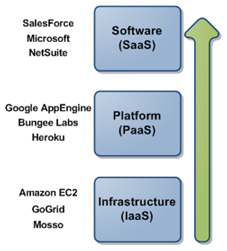
In the intervening months, a number of others have attempted to dissect the industry into a taxonomy. Robert Anderson came closest to our original breakdown by identifying three major buckets in his blog:image
I like the labels on the bottom two buckets, especially getting away from the PaaS label in favor of Platform. However, I don't agree on the top, as Software is too generic of a word. I prefer Applications for that bucket. Also, I believe a fourth bucket is necessary, to include a number of standalone components that are built on the platforms but are not applications. We called these Core Cloud Services in the first version, and I have labeled the bucket just Services this time around.
The updated stack that I will use in the taxonomy is as follows (starting at the bottom):
  • Infrastructure:  the core computing resources and network fabric for the cloud deployment
  • Platform: the software infrastructure that allows sys admins and developers to deploy an app to the cloud
  • Services: additional services that can be woven into the cloud app, such as billing, storage, integration
  • Applications: the ultimate cloud product - the actual cloud based application that the user touches. These number in the thousands.
You will note that the map is annotated with these buckets, with "1" denoting Infrastructure, and so on.

The Visual Industry Map

Below is the visual map as promised. You will find a larger version hosted here. An explanation of each category and a full clickable URL list of the solutions is offered below the map.
Please post comments with your feedback - they are very much appreciated. As before, there is no hope for this map to be comprehensive. I have selected a good group of vendors, but of course there are others that could have been placed on the map. My research notes are here, and they may explain why a particular vendor was left off.
What worked well before was for commenters to log the omissions, which I can evaluate and remedy in a later version. Also, Jeff Kaplan at THINKStrategies has created a SaaS Showplace database that is far more comprehensive.
Now, to the point, the map as promised:

Laird_CloudMap_Sept2008

Reference Vendor List

The following is the clickable list of each vendor displayed above.

Technorati Tags: ,,,

Tuesday, June 17, 2008

Best Practices for the Suspension or Termination of a SaaS Customer Account

No one wants to predict the failure of the relationship between a SaaS provider and customer. But much like a pre-nuptial agreement helps to quickly and fairly resolve the end of a marriage, a good up front contract helps ensure that both parties are fairly treated when a SaaS contract terminates. For this to work, the contract must have a well defined and fair set of terms for unwinding the relationship that works for both parties and minimizes business disruption. This blog entry proposes a set of rights for both customer and provider to use when establishing the contract terms.

This blog entry is a result of my analysis of a number of SaaS contracts. I covered the analysis in my previous blog entry. Note that I am not a lawyer, just an amateur contract sleuth so please engage a professional when working on your contracts.

SaaS Customer Bill of Rights

Other authors have created full blown Bill of Rights for SaaS customers. For example:

This blog entry is more focused. I am proposing rights that apply to both customer and provider when an account is on its way to being terminated.

Termination Rights for the Customer

I propose the following rights for customers whose account is being terminated:

  • Right to Business Continuity - customers rely on their SaaS products to conduct their business. Therefore, the provider must not have the ability to just terminate the customer's account without warning. A process must be in place to give ample warning before an account is terminated.
  • Right of Data Ownership - the customer must be able to extract their data upon termination, regardless of cause. The format of the extracted data should be as lossless as possible.
  • Right to Walk Away - the customer has the right to discontinue use of the service at the end of their contract. By exercising this right, they don't relinquish their other rights.

Termination Rights for the SaaS Provider

I propose the following rights for the provider that is terminating the account:

  • Right to be Paid - if you read about the SaaS business model, you will discover that cash flow is a major issue for the provider. Providers must carefully manage incoming cash and outgoing expenses. Anything that disrupts the predictability of the business will create major problems. Therefore, the SaaS provider has the right to expect timely payment, perhaps months in advance. If the customer fails to honor this right, the provider can quickly move the account into a suspended state.
  • Right to Protect the Service - if a customer account engages in malicious behavior or violates terms in the contract, the provider has the right to protect their service. In cases where the account is causing ongoing harm to the service (Denial of Service attacks), the provider must be able to immediately suspend the account. For less urgent issues, the provider should provide an appropriate warning before suspending the account.
  • Right to Fire a Customer -  businesses need to adapt to changing markets, and sometimes this means adapting or discontinuing products that aren't successful. For customers that no longer fit the profile of the business, the providers need to be able to discontinue their relationship with these customers. However, this process must honor the customer's right to business continuity.


Further Discussion

Hopefully each of these rights are obvious in their benefit. A couple demand more discussion.

Data Deletion - Where is the Mechanic's Lien?

Most Terms of Service assert that the customer owns their data. I am no lawyer, but ownership appears to be full legal ownership, like you would own a car or a house. See Netsuite's ToS as an example, but a clause like this is seen in almost every contract:

"Customer Data shall at all times be considered the property of the Customer."

However, some ToS documents allow the provider to destroy that data without providing the customer a copy in cases where the account is terminated for breach of the terms or failure to pay. This does not appear to be fair to the customer (as the SaaS provider is the prosecutor, judge and jury in this decision), and is inconsistent with physical property law in the U.S. (intl folks bear with me, I am focused solely on U.S. law here).

For example, if you don't pay a carpenter that performed work on your house, that carpenter does not have the right to burn your house to the ground. Instead, there is a process called the Mechanics Lien that requires the tradesman to pursue the money through a legal process, and he cannot harm the property in question. You could argue that data does not carry the same legal rights as physical property, but at least in some jurisdictions the law appears to treat data the same:

It seems that if a provider destroys their customer's data they open themselves to some legal liability. On the other hand, perhaps expressly reserving the right to destroy the data in the ToS alleviates the liability for the provider?  Is it worth the risk of finding out?

Regardless, destroying a customer's property is not a good business practice. Providers should treat the data like any of the customer's physical property. It should be returned undamaged because it legally belongs to the customer.

Business Continuity

Some Terms of Service allow for immediate termination of a customer's account with or without cause. In others, short periods of time like 30 days is all the notice necessary before the customer can be turned out. For mission critical applications, this is troublesome.

I feel there are a couple of key principles here to consider.

  • For no-cause terminations, the provider must provide as much advanced notice as it will take a typical customer to migrate to a new service. For services with high switching costs, this will be a period of many months.
  • For cases where the customer is in violation of the contract, the account should move into a suspended state before termination. This allows the customer to remedy the violation before the account is terminated. Suspensions are reversible, terminations are not.

These two principles are not widely implemented, but are critical in order to provide the customer with fair treatment.


Negotiate your Customer Contract

These listed rights are all well and good, but they won't likely appear in your contract by default. The contracts I have seen are largely skewed in the providers' favor because they were written by the providers. As a customer, I feel it is worth your time working towards more favorable terms. As shown in this blog entry, don't forget to negotiate the exit terms in the contract to ensure a viable migration when the time comes to end the project.


Technorati Tags: ,,,

Thursday, June 12, 2008

The Good, Bad, and the Ugly of SaaS Terms of Service, Licenses, and Contracts

Did you read your contract carefully before signing on with your SaaS provider? This blog entry shows you why it is important. Mixed in with some good stuff are some bad terms, and even down right ugly terms of use. Some vendors assert full rights to use and sublicense your private data! That's right, for the privilege of using their SaaS application, you throw in the rights for the use of your private data. Caveat Emptor!

The Analysis

This blog entry is a roll-up of an analysis I did of the Terms of Use for 8 different SaaS products. The products varied widely - some for the enterprise, others for the consumer. What the analysis showed is that there is little consistency across the legal documents governing the use of these services. It also showed some alarming terms that some of the sites demand.

I have picked out just the highlights to present here. The full analysis is available for download at the end of this post, but I warn you, it is quite boring.

Notice: I am an employee of Oracle, but this blog does not represent the views of my employer.

The Good

The following are the bright spots in the collection of ToS:

  • Netsuite: there are reports that this company has onerous licensing practices, but I see no evidence that. Of the 8 contracts I reviewed, Netsuite's is by far the best written and the most consumer friendly. They have the best data retention policies and termination procedures.
  • Boomi, Netsuite, Taleo: offer warranties for the various aspects of their systems, and not just "as-is". (see Boomi item 6.1, Netsuite section 3, Taleo item 11)
  • All but Concur: all of these services affirm that you own the data that you upload. This is key. However, there are a couple of vendors that reserve too many rights to use your data, see below.
  • Boomi, Coghead, Netsuite, Salesforce, Taleo: these companies indemnify the customer in cases where the application is found to infringe on a 3rd party's IP, and the customer is sued. Taleo is the only vendor of the 8 that does not demand to be indemnified in return from someone suing them for your use of the system.

The Bad

The following are terms that you should be wary of when entering into a service contract. Try to negotiate better terms:

  • Box.net, Coghead, Concur, Salesforce, Taleo, Zoho: these companies have contracts that can change at any time without any notice. In a way, this could be the ugliest line item of them all because the company could write in whatever nasty thing they want. But I will leave it at "bad" until one of the companies does something evil with it. (see Box.net item A, Coghead item 6.2, Concur item 8, SFDC item 21, Zoho item Mod ToS)
  • Salesforce, Taleo: have a line item that allows the company to advertise your name as a customer, merely by signing up for a paid account. Customer references should be earned, not mandated. (SFDC item 1, Taleo 7.1)
  • Salesforce: prohibits direct competitors from using the Service. But at the rate SFDC is expanding offerings, will you become a competitor tomorrow? For example, anyone that offers software development tools became a competitor when they launched force.com. (see SFDC item 2)

The Ugly

The following is the list of contract terms that are unacceptable. I would not recommend using the following services unless you negotiate better contract terms. [Update:to be clear, I don't think these companies are out to do evil, I am merely sounding the alarm to their contract terms]

  • Box.net: [Update: Box.net has fixed this issue in their contract, by narrowing dramatically the scope of their rights to your content] by uploading content that you own to this service you are giving Box.net an irrevocable license to use, copy, create derivative works of, sublicense, etc etc of your content. Think about that. The only redeeming argument is that this contract is for personal, not business use. But they put this item in there for a reason - why? Imagine uploading your personal pictures and then seeing one in the next promotional campaign for Taco Bell. This could happen because Box.net has the right to sublicense as they wish. (see section D)
  • Coghead: if Coghead terminates your account, you have just 2 days to send written notice to request your data. Otherwise they can permanently delete all of your data. What's the rush? (item 7.3)
  • Concur: (caveat: this is the Trial license, which can only be assumed to match closely the production license) has the most worrisome contract as it relates to your data. It is the only one that has no explicit line to indicate that you still own your data (filed business expenses, in this case). But it does have a line saying that Concur has an irrevocable right to use that data - this includes your personal data and financial info! Why is this in the contract? This seems quite broad for data that is of utmost sensitivity. (see item 5)

Links to the Terms of Service

The following is a list of links for you to inspect the contracts for yourself:

Box.net http://box.net/static/html/terms.html

Boomi: http://www.boomi.com/application/Boomi+Master+Subscription+Agreement-Online.pdf

Coghead: https://www.coghead.com/user/register?plan=Pro

Concur (Trial license): http://www.concur.com/register/Concur-Expense-Trial.php

Netsuite: http://www.netsuite.com/portal/pdf/tos.pdf

Salesforce: http://www.salesforce.com/company/msa.jsp

Taleo: http://www.taleo.com/solutions/licensing-terms.php

Zoho: http://www.zoho.com/terms.html

Raw Analysis

The following link provides you with the spreadsheet I built while analyzing the licenses. The spreadsheet contains the list of common license clauses with pointers into the documents on where to find those clauses.

What it shows most of all is the lack of commonality across all of the licenses. Each document has a lot of variance.

Download: SaaS "Terms of Service" Analysis Spreadsheet

Account Suspension/Termination and the Deletion of Data

I found that the process by which accounts are suspended (reversible) or terminated (irreversible) wildly inconsistent and mostly incorrect in my opinion. Because termination is also coupled with data deletion, this process needs to be well understood and incredibly fair to the consumer. My next blog entry will focus on this part of the contract, and establishing a reference workflow.

Thursday, May 29, 2008

SaaS Soup: Navigating the "as a Service" Acronyms: CaaS, DaaS, DBaaS, PaaS, SaaS, XaaS

Ever wonder what all the "aaS" acronyms mean? Do you want to understand how they relate to each other? This blog entry will help. I have created a map of many of the "as a Service" terms you will see in IT and have grouped them according to category. I have also provided an explanation and links for further reading for each so you can quickly come up to speed on all. 
I put this together because I am working on the second edition of a visual map of the SaaS, PaaS, and Cloud Computing industries that I released last month. In order to make progress on that map, I found I needed to have a better understanding of all of the common categories in the "as a Service" market. The map in this blog entry has a different focus - instead of mapping out industry players I am mapping out industry terminology. Both maps complement each other.

Map of the "as a Service" Terms

This graphic shows the groupings of the "as a Service" terms that you may encounter in the IT industry. Click the map for a larger view.
aaSTree_Laird_May08


Top Level IT Service Categories

This section lists the primary categories around computing as a service. These categories serve as the larger buckets into which we will place the finer grained "as a Service" terms.

HaaS

Hardware as a Service
Humans as a Service
  • What: service offerings that primarily require humans beings to deliver (aka professional services)
  • Not an industry term, but necessary to properly categorize some of the "as a Service" offerings
  • OK, I don't mean prostitution wise guy

PaaS

Platform as a Service
  • What: hosted software that serves as a platform for building SaaS offerings
  • There are different types of PaaS products, and sometimes HaaS products are mistakenly called PaaS
  • Some PaaS products may be optionally deployed on HaaS products such as Amazon's EC2
  • Examples of PaaS: force.com, Bungee Connect, Google App Engine, Etelos, QuickBase, LongJump, Apprenda SaaSGrid

SaaS

Software as a Service
  • What: in its most generic form, any software offered remotely as a service. Since this definition includes the entire world wide web, there are generally agreed on criteria for SaaS products to narrow the scope:
    • Primarily business software
    • Usage based pricing (pay as you go) with no long term contracts
    • Delivered over the internet, primarily via a browser
    • Managed by the ISV that developed the application (as opposed to the former ASP model)
  • Wikipedia: SaaS
  • Alternate form: Microsoft has pushed the term "S+S", which is a SaaS solution paired with on-premise software

List of "as a Service" Terms

This section lists many terms you will find referring to a "as a Service" offering in the IT industry. They are organized by acronym - sometimes the same acronym may refer to multiple terms. For each term, a few links are provided for further reading.

BaaS:

Backup as a Service

CaaS:

Communications as a Service
Compliance as a Service
Content as a Service (aka Content On Demand)
  • Category: SaaS  (note it may directly employ Storage as a Service for the actual storage of the docs)
  • What: offering a hosted content repository, including workflow, versioning, checkin/checkout
Crimeware as a Service
Computing as a Service
CRM as a Service

DaaS:

Data as a Service
Data Warehousing as a Service (or DWaaS)
Data Mining as a Service
Database as a Service (or DBaaS)
Development as a Service
Desktop as a Service
Document Management as a Service

EaaS:

Ethernet as a Service
  • Category: HaaS
  • What: a solution provided by network carriers to provide virtual ethernet capacity from a much larger line
  • SearchTelecom.com: Ethernet as a service (EaaS)
ERP as a Service (or ERPaaS)
Email as a Service

HaaS

Human Resources as a Service (HRaaS), Human Capital Management as a Service (HCMaaS)
  • These terms are not used yet, but probably coming soon to a Workday blog near you

IaaS

Information as a Service
Infrastructure as a Service
Integration as a Service
Identity as a Service

MaaS

Malware as a Service
Manufacturing as a Service
Mashups as a Service
Media as a Service (as in: video, audio)
  • Category: SaaS, a subtype of Data as a Service
  • What: providing hosted access to audio/visual services
  • Chris Saad: MaaS - Media as a Service 


QaaS

Queue as a Service

SaaS

Security as a Service
  • Category: SaaS
  • What: the delivery of security capabilities using a SaaS model
  • Wikipedia: Security as a Service
Storage as a Service

TaaS

Testing as a Service
  • Category: Humans as a Service
  • What: outsourcing the testing of software
  • TAAS Services 

UaaS

UI as a Service

VaaS

Voice as a Service

Everything Else

Confused? Think all of these acronyms and terms are ridiculous? You aren't the first.
In recognition of the proliferation of "aaS" terms, umbrella terms have also appeared:

Previous Acronym Round Ups:

This isn't the first attempt at rounding up all the XaaS variants. You can find previous attempts here:

Technorati Tags: ,,,

Thursday, May 8, 2008

Twitter Microfeed Covering the SaaS/PaaS/Cloud Markets for those without a Cognitive Surplus

Most of you have probably seen Clay Shirky's material on the great Cognitive Surplus - the free time that everyone wastes by watching TV. Awesome stuff, but if you are trying to keep up with all the activity in the SaaS, PaaS and Cloud industries by definition you have no Cognitive Surplus. We are in information overload. Subscribing to specific feeds or Google Alerts can help isolate the signal from the noise, but sometimes even that can be challenging. Let me propose a solution: I have created a microfeed for this space on Twitter. This blog discusses how you can subscribe to this feed and stay in touch with the news in a very lightweight way.

 NOTE: this blog entry was originally posted May 8th, 2008 on my previous blogging system (dev2dev.bea.com).

Twitter and the 140 Character Budget

We had email, then we added instant messaging, and now we have Twitter. What is the trend here? Brevity. Stop with the 3 page emails and get to the point. Its all about time, and we don't have enough.

For those who haven't already taken the plunge into Twitter, let me explain its single most rewarding feature. It limits each message (tweet) to 140 characters. It forces brevity on the author, and this is a very good thing. Like telegrams of the past, authors need to choose their words (actually, characters) very carefully to get their point across in those precious 140.

For Twitter subscribers, this means you get messages that are short and to the point. What's not to love.


Twitter Microfeeds

Twitter began as a personal messaging platform. The message publishing box asks "What are you doing?" The intent is to keep your buddies apprised as to what you are doing throughout your day.

But the Twitter community being who they are have found creative uses for this messaging platform. Microfeeds (a term I prefer to Twitter Feeds), are one such use. The idea being that there is utility in getting short alerts on news throughout your day without being disruptive. This doesn't replace the full RSS scan you do when you have the time, but helps to keep you informed when you cannot spare time to do even that. Coupled with the option to receive your Twitter messages via SMS on your phone, it is also a way to stay informed even while you are out and about.

There are at least two ways to publish a Twitter microfeed:

  • Using an automated service like TwitterFeed to watch an RSS/ATOM feed and pump the first 140 characters of each entry to Twitter
  • Hand crafting the feed to fine tune each message

The former is the most timely and easiest, but can be very noisy if you are aggregating many feeds, and may not convey a lot of information in the message since it just grabs the title and maybe a few more characters from the entry. A handcrafted approach assures the readers that they are getting quality messages.


Introducing the SaaS/PaaS/Cloud Microfeed

That was all very abstract. What is important to know is that I have created a handcrafted microfeed for S/P/C and encourage you to try it. I plan to be very selective in posting the following types of information in the space:

  • Major deals, acquisitions
  • Product launches
  • Call for Papers for upcoming conferences
  • Notice of upcoming events, like webinars
  • Insightful blog posts

For an SLA, I will attempt to stay under 20 messages per week, with a target load of 2-3 per day. But as we go along, please give me feedback as to content and quantity.

As a sample, here is the feed as it currently stands right now:

Boothby: Joyent video collage of interviews at Web2.0Expo "what is cloud computing" . Tim O'Reilly, others. http://tinyurl.com/5ngh6d about 3 hours ago from web 

Wainewright: Taleo acquires Vurv, joins SaaS revenue all stars SFDC, Omniture, Concur http://blogs.zdnet.com/SAAS/ 08:38 PM May 06, 2008 from web

IBM: Call for Papers for IBM's "Info On Demand" conference (Oct. 26-31), http://tinyurl.com/4fljg5 08:49 AM May 06, 2008 from web

MySQL: offering webinar May 15, "Multi-Tenant Architectures with MySQL Enterprise for SaaS Providers". Register: http://tinyurl.com/4pwk4r 08:34 AM May 06, 2008 from web

Craig Balding: NPR (radio) featured him and Cloud Computing for 3.5 minute segment. To listen, see: http://tinyurl.com/4amvdx 02:14 PM May 05, 2008 from web

Mosso: (Rackspace's cloud division) launches Storage-aaService CloudFS private beta, $0.15 per gigabyte http://tinyurl.com/48h4ql 02:06 PM May 05, 2008 from web

Bungee: revise 4/30 tweet - Pg/MySQL anncment is not a hosting offering, support is for connectivity only. See: http://tinyurl.com/5yfnnd 01:41 PM May 05, 2008 from web

Kaplan: THINKStrategies supporting SaaS industry study, call for SaaS providers with rev $10M-250M http://tinyurl.com/578c5b 01:36 PM May 05, 2008 from web

Willis: provides a listing of cloud solutions predating the Laird SaaSMap. "Cloud Vendors A to Z" http://tinyurl.com/67fcau 01:33 PM May 05, 2008 from web

Druker: financial SaaS provider Intacct raises another $15M to help battle Netsuite. Total funding so far $29M http://tinyurl.com/6qvpl3 10:08 AM May 03, 2008 from web

Laird,Dickson: created a visual SaaS/Cloud/PaaS industry map, showing the major focus areas and players. http://tinyurl.com/45ejjj 09:49 AM May 03, 2008 from web

Wainewright: MSFT to try MSOffice stream ondemand (not in cloud) with license change. See also EndeavoursTech. http://tinyurl.com/4qj9nv 09:42 AM May 03, 2008 from web

Wainewright: SAP disaster - delays SaaS 12-18 months after validating market. Gift to Netsuite, Twinfield, CODA. http://tinyurl.com/49rtfs 09:34 AM May 03, 2008 from web


Subscribing to the ondemand Microfeed

The Twitter account being used for this microfeed is:

For those already on Twitter, just follow that account and be sure to enable device updates for it. For new users, follow these instructions:

  1. Create a Twitter account, using whatever name you like
  2. Skip the email search wizard
  3. Search for the "ondemand" user using the search box
  4. Click the Follow button

To subscribe your phone to get an SMS message whenever a new post appears, do the following:

  1. Click Settings in the upper right
  2. Click Devices
  3. Enter your phone number, and be sure to check the box to approve SMS
  4. Click the Home link at the top of the page.
  5. Click on the Following link on the right hand side of the page
  6. Click the on button for device updates for ondemand


Twitter Clients

There are many ways to stay on top of this Twitter microfeed. I am optimizing for readability on SMS but really any client will do.

  • The traditional Twitter website user interface
  • Enable device updates for the ondemand account, and you will receive SMS messages
  • Thwirl - a powerful desktop client
  • Facebook integration


Friday, May 2, 2008

Understanding the Cloud Computing/SaaS/PaaS markets: a Map of the Players in the Industry

The Cloud Computing/SaaS/PaaS space is loaded with interesting vendors, and the space is booming. If you are trying to navigate this world and need a guide, this blog entry will help. We have assembled a visual map of the industry, showing how the major players fit into the overall space. It will give you an overview of who's who, and what types of solutions are being offered.

NOTE: a newer version of this map is now available. Click here to navigate to the most recent research.

I was greatly assisted by Kent Dickson, VP of Product Management for SaaS at BEA, in building this map. Steve Bobrowski, Director of SaaS Evangelism, also contributed comments. Thanks to both!

Defining the Markets

Before we look at the map, we need to define the major areas that we are covering. Note that in many ways these markets overlap so trying to differentiate which solution is in which is not a meaningful exercise. Needless to say, drawing out the map is a subjective effort, and not all solutions fit neatly into their assigned bucket. The purpose of the visual map is not to address subtleties, but to draw the industry in general terms.

Cloud Computing

Cloud computing refers to the virtualization of the data center, such that server machines are not thought of individually but as just a commodity in a greater collection of server machines. Cloud computing solutions in general strive to eliminate the need for an application deployer to be aware of the actual physical machines that are used to host the application. Some have called this idea “hardware as a service”.

Solutions that are most closely associated with the Cloud Computing market are indicated with the image icon on the map.

Software as a Service (SaaS)

An application that is delivered through the SaaS model typically is done so:

  • Over the internet,
  • Remotely by a third party, with little/no opportunity to bring that application in-house
  • With a usage-based pricing model

Solutions that are most closely associated with the SaaS market are indicated with the image icon on the map.

Platform as a Service (PaaS)

When a vendor offers a Platform as a Service, they are offering an integrated platform to build, test, and deploy custom applications. The PaaS is offered to you in a SaaS model (remote, usage-based). Dion Hinchliffe recently published a comprehensive whitepaper on this topic.

The PaaS market is indicated with the image icon in the map view.

Core Cloud Services

After defining the 3 markets, there remains a set of solutions that contribute to all as fundamental building blocks. In other words, these solutions address cross cutting concerns.

In the map they are marked with a distinct icon image to set them apart.

The Visual Map

Below is the visual map as promised. You will find a larger version hosted here. An explanation of each category and a full clickable URL list of the solutions is offered below the map.

If you wish to make changes, the original mind map drawing file assets are located here. Please post comments with your thoughts, or use this map as a basis for your own vision of the industry. Please give credit back to the original source (see Creative Commons) if you do.

SaaSMap_LairdDickson_May08

Defining the Solution Groupings

In the map, we grouped solutions according to the problems they aim to solve. This section details the intent of each category.

Please note that for every category, there are more vendors that could be included. We are not attempting to provide a comprehensive list of every player in the industry. THINKStrategies created the SaaS Showplace if that is what you are looking for.

This map only shows solutions that are both 1) available in some form today, and 2) have significant mindshare in the industry. Feedback is appreciated if you disagree with any solution that was included or excluded.

Left Side

Cloud Providers - vendors who provide server hardware in commodity form, as a virtualized cloud

Cloud Deployment - solutions surrounding the deployment of applications to a virtualized cloud

Virtual Appliances - packaging and virtualization format solutions for provisioning applications into a cloud

Topology Management - solutions focused on the coordination of many virtual appliances (app, DB, network) in the cloud to form a full deployment

Billing, Contract Management - solutions that provide metering, billing, pricing, and contract management to help charge for use of a system

Security - solutions focused on solving security requirements in these markets

Data - services that deliver/retain data for applications

Hosters 2.0 - Hosting Service Providers with SaaS focus. Perhaps a controversial grouping and impossible to define, these hosters tend to appear over and over in these markets

Nerd Stuff - geeky topics fall into this category. MapReduce is mechanism for solving large computing tasks, like Google Search indexing

Right Side

On Demand Apps - the heart of the SaaS market, only a few depicted here but we could add "...and a cast of thousands". These are the end application products offered for consumption in a SaaS model

Integration as a Service - service solutions that help in integrating multiple systems, possibly multiple SaaS systems

Content as a Service - hosted content repositories

BPM and Workflow - service based offerings for managing workflow and process

Platform as a Service - incarnations of the PaaS concept

Reference Solutions List (with clickable links)

Cloud Computing,
SaaS, and PaaS
Industries
2008

Technorati Tags: ,,,
Comments from the original blog:
  • Very useful chart. You've misspelled Itensil (not Intensil)in the BPM as a service node -- the website link works though, so don't change that. I'd argue that Itensil is really a PaaS product with pre-built workflow, and invite your readers to have a look and let me know if you agree.

    Posted by: kpatterson on May 16, 2008 at 12:34 PM

  • FYI - I will be working on an updated map shortly. The feedback is still rolling in. thanks for all the email/comments.

    Google - yes, they are listed as a PaaS with their new App Engine offering

    MorpheXchange.com - thanks for the note, just published an entry on them on my Cloud/PaaS/SaaS microfeed

    And thanks to OpSource for the mention today of the map in their monthly newsletter.

    Posted by: plaird on May 14, 2008 at 1:24 PM

  • Very interesting article. Just two questions -- Did Google recently add an offering to the cloud computing space ? Is a company called mediamax.com involved in the storage-as-a -service category ?

    Posted by: hsr0508 on May 14, 2008 at 11:22 AM

  • I'm a bit cautious of messing with the wiki list Peter but may I also point you to MorpheXchange.com as one of the emergent PaaS players particularly incorporating open source technologies to guard against the lock in fear. Incidentally, the platform has opened itself to Java after debuting Rails. Check them out. Best. alain

    Posted by: friarminor on May 13, 2008 at 9:34 AM

  • Peter Thanks for the feedback, much appreciated. Looking forward for your comment on my post:)

    Posted by: natishalom on May 6, 2008 at 8:03 PM

  • Nati - thanks for the comment, this is what I am looking for. Responses:

    Rightscale, MySQL, Coherence, GigaSpaces, etc: maybe not all of those, but I also have been getting emails offline, and will need to make a v1.1 of the map to include a handful of corrections/omissions. The feedback is still coming in, so will wait a little while. I don't want the map to turn into a 1000 node monster, so I want to be very selective. Jeff Kaplan's SaaS Showplace is the comprehensive source backing all of this.

    Oracle SaaS Platform: this was a late addition, and upon further reflection not exactly right. I now see the Platform bucket broken into two, with PaaS (minus ORCL). Then with a new bucket perhaps containing on-prem platform software that is "SaaS ready". Still noodling on this though.

    Your blog: thanks for the link, I wasn't following your feed, now I am. I would agree in general about lock-in, not totally on board will all of your conclusions. I am deciding whether to add a comment to your blog, write a response blog entry, or succumb to laziness and just let it be. :)

    Cheers - PJL

    Posted by: plaird on May 6, 2008 at 10:23 AM

  • Interesting review. It captures many of the players in this emerging space.
    I think that your missing some important platforms such as RightScale.
    I also wanted to point out that one of the main problems with Platform as a Service that are mentioned is the fact that offer radically proprietary solution. In your list there are few that i rarely heard of in that context such as Oracle SaaS platform..
    I recently wrote a post describing other platform choice that can help building SaaS applications in a way that could be easily ported to any cloud environment. It support also existing Java/Spring and .Net frameworks. In this way you don't have to switch entirely to completely different proprietary framework to leverage the value of cloud based environment.
    The post is available here:
    Google App Engine - what about existing applications?
    You can also view Dave Rosenberg post that points to other frameworks on that regard Sun's OpenSolaris on EC2--overcast but not completely Cloudy
    On the data services side i think that your missing few important and common services that are used by many of the applications running on cloud today such as MySQL, and other data-caching services such as Oracle-Coherence, GigaSpaces, Terracotta, Memcache etc. Some of which integrates with SimpleDB thus providing in-memory front end for better performance and reliability. (See example here SimpleDB such as the one with SimpleDB)

    Posted by: natishalom on May 6, 2008 at 4:51 AM

  • Hi Jim - good questions.

    A lot of parallels are drawn between the ASPs of the 90's and the SaaS providers of today. One of the key differentiators is that SaaS does not require the tenant to make a large upfront payment like they did in the ASP/outsourced model. SaaS is offered with usage based pricing - e.g. you pay $50 per user per month. There are other differentiators, but that is key.

    As for the zero customization solutions being very limited, I think you are right. Per-tenant customizations are critical for the enterprise, be it UI, data model, business process, etc. I think all SaaS vendors are working on solving this, and some have solutions today.

    I posted a list of SaaS podcasts which offer a much more in-depth response to your questions. I found them very helpful in explaining what is happening in the industry.

    Thanks for the comment! PJL

    Posted by: plaird on May 5, 2008 at 10:30 AM

  • This topic is getting a ton of exposure right now, I just finished the Wired article on Amazon's EC2 http://www.wired.com/techbiz/it/magazine/16-05/mf_amazon I have a number of questions on this topic, I'll start with Isn't this simply Outsourcing 2.0? IBM,AmDocs,etc... host infrastructure for many of our customers, you happen to know the hardware, os, and IP of the machine it is running on, change it to a cloud of resources (virtualize and absract it), and change the pricing model...Voila outsourcing 2.0. SaaS gives you more than outsourcing, but SaaS to me is not going anywhere fast, and is only riding the buzz of cloud computing. Cookie-cutter (no customization) solutions offering no diversity from the competition who are all using the same service. I see value in the space, but I have the feeling this is more hype than real value.

    Posted by: jcalise on May 3, 2008 at 10:14 PM

  • Great article Peter, I now have a much better idea of the space. Did not realize was that many players involved. Thanks for sharing this data! Cheers, --alex

    Posted by: atoussai on May 3, 2008 at 7:59 PM

  • Excellent break down of the space, and a great reference to use going forward.

    Posted by: jcalise on May 2, 2008 at 10:45 AM