Showing posts with label ondemand. Show all posts

Tuesday, May 19, 2009

Cloud Computing Taxonomy at Interop Las Vegas, May 2009

If you have read my blog in the past, you will know that my schtick in covering the Cloud Computing and SaaS space is taxonomies. I have created a number of them, and have been an invited speaker to talk about them. Here are a couple of examples from the past:

Peter at Enterprise Cloud Summit

Yesterday, I spoke on the topic of taxonomies at Enterprise Cloud Summit, a conference within a conference at Interop Las Vegas. I was impressed by the turnout despite the economy – Alistair Croll did a great job putting together a great speaker list which in turn drove a lot of traffic into the sessions. My session went early on the first day, so it was my job to setup the landscape of the Cloud Computing industry. The taxonomy was perfect for that task.
Cloud Summit

May 2009 Cloud Computing Taxonomy

In support of my speaking at Interop, I have updated my Cloud Computing taxonomy. I have restructured the buckets a bit since the last time, and of course I have added some new vendors that have come on the scene. I have also removed a couple of solutions that have since exited (or have appeared to exit) the market – Coghead, Skemma, and Mule OnDemand. Cassatt, while not done yet, is marked with an asterisk to indicate its current status.
A few additional notes about the construction of this map:
  • There is a size limit, so not every vendor in every bucket can be covered. I include what I think are the major players, and include others as space allows
  • Some vendors could fit in multiple buckets, but generally I place the vendor in their main area expertise only
  • There are several categoris – hardware, virtualization, system integrators – that I don’t include at all. I find that they are spaces that deserve entire maps on their own.
  • News rolls in every day – AT&T just announced a Cloud storage solution. Please add a comment if you see a vendor that is missing that you feel should be included.
  • Some of these “vendors” are not actually vendors – some are open source solutions.
And a final word before presenting the map – I always recommend a different source for those who want to see a more exhaustive list of vendors in this space. Jeff Kaplan of THINKStrategies has created a SaaS Showplace which is an exhaustive catalog of vendors.
Cloud Taxonomy April 2009_final
(Click on the image for a larger version)

Descriptions of the Buckets:

To provide some insight into what each bucket means, listed below are descriptions.

Infrastructure

  • Public Clouds – the poster children of Cloud Computing. These vendors offer computers as a service. If you need 50 computers in 15 minutes, these guys will take care of that. Differentiators include the provisioning model (virtualized instances vs. actual machines) and the host OS versions that are supported.
  • Private Clouds – these solutions help enterprises build private clouds within the firewall. If privacy and control is a big concern, or you want to increase utilization in an existing data center, a private cloud may be what you want.
  • Compute and Data Grids – while these solutions are also useful outside of a cloud, they can play an important role for applications that are deployed within a cloud. The key difference with Cloud applications from traditional on-premise applications is in how they must scale. With an on-premise application, you can scale vertically when the load gets too high – by buying a bigger machine. In the cloud, applications must scale horizontally – by adding more machines in a cluster. Compute and Data Grid products can help achieve horizontal scalability.
  • Virtualization and Appliances – when deploying OS stacks to public and private clouds, you will find it helpful to have a library of virtualized OS images. The vendors in these buckets will help in this area. Also, depending on the cloud being used, any number of Virtualization technologies will be used.

Platform

  • Business User Platforms – these platforms are cloud based application development environments. The focus of these platforms are on non-programmers as the application developers. To make this happen, these platforms offer rich visual tools to enable the developers to define data models and application logic. The differentiators for these platforms are their features – which is important to investigate during software selection as there is no coding allowed, so developers cannot code around feature outages.
  • Developer Platforms – these platforms are cloud based application development environments that support custom coding. Developers can build highly customized applications with these platforms, without having to worry about scalability, OS configuration, load balancing, operations, etc as they would with a public cloud offering. The differentiators for these platforms include the supported programming languages (Java, python, custom, etc), and data storage capabilities (RDMBS, key-value stores, etc).

Services

  • Storage – these vendors offer hosted storage that are API accessible. Meaning, any application can get/set objects into these Cloud storage solutions. The solutions vary in the supported data access models – key-value stores, file stores, etc.
  • Integration – solutions that provide integration facilities between multiple Cloud applications, or Cloud applications with on-premise applications. Major features offered are: messaging queues, business process modeling (BPM), and application adapters (like NetSuite adapter, SAP adapter).
  • Metering and Billing – building your own billing and invoicing system is highly discouraged. This is a great operation to outsource to a specialist. These vendors offer expertise in how to structure billing plans, plus all of the back office capabilities behind invoicing and collection. By outsourcing to one of these PCI compliant vendors, you will reduce the level of compliance your Cloud application will need to attain.
  • Security – The Cloud infrastructure and platform vendors must provide security, and so a base level can be assumed. But for value-add features, like application authorization features, encryption, and Single Sign On capabilities across multiple applications – look to these vendors.
  • Fabric Management – this is a space that evolves quickly, so you will need to keep up to date on new developments with these vendors. Generally, these vendors help you manage and deploy your application in the Cloud. This varies from features that allow you to design a virtual data center in a cloud, to auto-scaling an application when load increases, to monitoring Cloud servers to restart them if they fail.

Applications

  • SaaS – these vendors represent the ultimate end-game to all of this – Cloud based applications. There are thousands of them, and are traditionally known as Software as a Service (SaaS) applications. SaaS applications are available over the internet, are quick to provision a new account, are offered in a pay-as-you-go model, and allow some level of customization. NetSuite, Salesforce.com, Taleo, Concur, Workday and many others have established the space as a viable way to deliver software.

Vendor Links

Below are links to each of the vendors and solution depicted above.

Please Comment

I have found some of the vendors above via comments placed on earlier versions of the map. If you know of a solution that you feel should be included, please post a comment on the blog. I can’t promise I will add it (the map is size limited), but I would like to see other solutions. Thank you!

Monday, September 15, 2008

Comparing Cloud Computing Mindshare Levels Between the U.S., Europe, and Asia

Would you believe that the U.S. has 4 times more people interested in cloud computing than Europe? How about 5 times more people so interested than Asia? It is impossible to derive irrefutable evidence to validate those statements, but this blog entry offers one concrete data source that indicates those statements are true.

There have been various studies on cloud adoption and mindshare. For a young industry, it is an important metric to understand. Just this week, Chris Marino started a cloud adoption topic thread on the Cloud Google Group. He cited the Pew's report on American adoption of cloud applications.

This blog entry provides more data for that discussion. However, it focuses not on the adoption rate within the U.S., but the relative interest in cloud computing topics across continents. It uses traffic data from my blog as the input into the analysis.

Aggressive Extrapolation

Just to give you fair warning, I am about to draw sizable conclusions from a single source of data. This data source, traffic to my blog, cannot be proven to be a meaningful measurement. But I am writing this blog entry anyway because I think it is an interesting topic and the data might be meaningful. Also, I find there is an absence of information on this topic out on the net, so I hope this is a good starting point for other studies.

Here are a couple of assumptions I am making during this analysis:

  • Given that blog access is location independent, there is an equal opportunity across regions for any cloud computing enthusiast to read my cloud blog entries
  • Given equal opportunity, the readership of my cloud blog entries roughly matches interest level in each region for the topic of cloud computing in general

You could certainly argue that my blog does not generate enough traffic to be a significant measure. You could also argue that the level of blog readership in general isn't consistent across the regions.

You could also probably find about ten other reasons why this study is not conclusive. Once again, I hope this is a starting point for others to contribute meaningful data, and so this blog entry will be published despite the possible objections.

The Raw Data:  Blog Readership Numbers

I will first introduce the raw visitor numbers of a handful of blog entries, as captured by Google Analytics. Later sections will explain the data and what to look for in these numbers.

Blog Entry Cat
gory
Visits U.S. % Europe % Asia %
Cloud Taxonomy V2 Cloud 1631 67 17 13
Cloud Taxonomy V1 Cloud 1172 63 20 15
SaaS Taxonomy SaaS 207 54 18 26
SaaS for IBM, ORCL... SaaS 191 40 32 25
SaaS Contract Analysis SaaS 196 69 22 8
Control 1 Ctrl 131 51 27 16
Control 2 Ctrl 363 53 24 21


A few words on the data collection gathered from Google Analytics:

  • These numbers reflect visits between July 1, 2008 and September 14th 2008
  • Some of the entries were not available during the entire collection period.
  • They do not include RSS readers, as my feed exposes the entire entry
  • Some of the older entries started life on a different blog system before being migrated to this blogspot account in May. Some clicks may have gone to the older blog system for those entries and were not captured.
  • Visits are unique visitors, which each may account for one or more pageviews
  • The numbers don't add up to 100% due to hits coming from places outside the three regions

Primary Evidence: Cloud Computing Visual Map Entry

The primary piece of evidence, and the one from which I drew the main conclusions, is an entry made on September 8th 2008. It is titled "Cloud Taxonomy V2" in the table above. The blog entry contains the second version of  a vendor map I have drawn that visualizes the cloud computing industry. I pick this entry as the primary evidence for the following reasons:

  • It is very recent, and therefore very "clean" in terms of tracking actual human users reading the entry
  • It is an entry with general appeal - it covers the industry as a whole. It therefore should represent a broad measurement of interest.
  • It has enough visitors (1631) to make for a good sample size

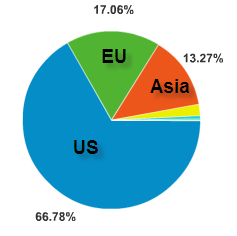
The evidence reveals the following distribution:

image

It is from this data that the main conclusions are drawn:

  • U.S. interest in the topic of cloud computing is 4 times greater than in Europe
  • U.S. interest in the topic of cloud computing is 5 times greater than in Asia

Look also at the numbers associated with the blog entry listed as "Cloud Taxonomy V1". That was the first version, released in May of this year. It is comforting to see that the V1 numbers roughly match the V2 numbers.

What About the SaaS Numbers?

You will notice that the SaaS themed blog enties don't carry the same distribution as the cloud entries. This is odd, as SaaS is a subset of cloud computing (see the referenced taxonomy diagram if you want to see why).

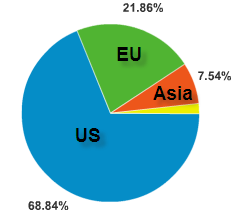
Specifically, look at the first two SaaS blog entries, found here and here. See how the U.S. has a lower share of the readership than with the cloud taxonomy entries:

image

One fabricated explanation - its about early adopters?

  • The U.S. contains a higher percentage of early adopters (hypothesis)
  • The overall cloud computing industry is still quite young , and dominated by early adopters. Therefore, the U.S. has a greater share of the readership of the general cloud taxonomy entries.
  • SaaS is further along in adoption than the overall cloud computing industry. Therefore, you will see more balance in the interest levels.

Now look at the third SaaS entry - the one titled SaaS Contract Analysis. This one actually shows a higher distribution for the U.S. relative to the cloud taxonomy entries. Why?

image

Once again, a totally fabricated explanation - does this show Adoption as opposed to Mindshare?

  • The SaaS Contract blog entry contains an analysis of SaaS contract terms, and suggested terms to avoid as a customer.
  • This is not an entry for future thinkers or those just kicking the tires. This entry is primarily useful for those actually implementing SaaS and who need to review contracts with vendors. Perhaps this may show actual adoption, while the data for other entries show mindshare/interest?

Seeking a Control: My Non-Cloud/SaaS Blog Entries

While in recent times I have focused my external writing on Cloud Computing and SaaS topics, I also have written on topics such as mashups and Java security. To help shed more light on the numbers revealed above, I offer two of those blog entries as a control for this analysis. These may indicate what bias already exists in my blog readership.

Or they may not - most of my readers find my blog via search engines, not because they are regular subscribers. Therefore I would argue that these other blog entries don't offer much insight. But they are included anyway for your review.

Other Data Points on Cloud Mindshare and Adoption

There are other publicly available surveys on various adoption rates and mindshare. I would contend that none of these provide data for the specific discussion above, but they are interesting all the same:

Call for Collaboration

This analysis would be helped immensely by having access to more data sources. Cloud bloggers - what are you seeing? Cloud vendors, what can you say about your customers? Please reveal!

Also, the raw spreadsheet data from Google Analytics for my cloud v2 entry is here. If you would like a different export of the data, let me know.

Monday, September 8, 2008

Visual Map of the Cloud Computing/SaaS/PaaS Markets: September 2008 Update


NOTE, New Version Available:

This version of the map is now outdated. I have released a new version of this map for Enterprise Cloud Summit at Interop Las Vegas. Follow this link for the latest version.

Interop NYC 2008

Four months ago, Kent Dickson and I created a visual map of the Cloud, SaaS and PaaS industry. It proved to be a popular item - we got a lot of comments and continue to see traffic to my blog page. I was long overdue to create a second version - comments needed to be integrated, and the industry has changed enough to warrant a round of updates. This blog entry contains an updated version of the map.
The timing is no accident. I will be speaking at the Interop NYC 2008 conference on September 15-19. I will be presenting on the topic of Cloud Taxonomy. My slide deck was submitted last month, but I want to have a fresh version of this taxonomy to present. Thus, the tyranny of the deadline has forced my hand.

Defining the Markets

In the first version of the map, the players were divided into four major buckets (from the bottom up):
  • Cloud Computing
  • Platform as a Service (PaaS)
  • Software as a Service (SaaS)
  • Core Cloud Services
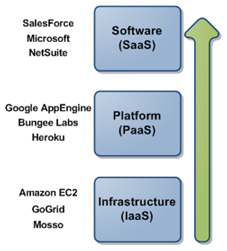
In the intervening months, a number of others have attempted to dissect the industry into a taxonomy. Robert Anderson came closest to our original breakdown by identifying three major buckets in his blog:image
I like the labels on the bottom two buckets, especially getting away from the PaaS label in favor of Platform. However, I don't agree on the top, as Software is too generic of a word. I prefer Applications for that bucket. Also, I believe a fourth bucket is necessary, to include a number of standalone components that are built on the platforms but are not applications. We called these Core Cloud Services in the first version, and I have labeled the bucket just Services this time around.
The updated stack that I will use in the taxonomy is as follows (starting at the bottom):
  • Infrastructure:  the core computing resources and network fabric for the cloud deployment
  • Platform: the software infrastructure that allows sys admins and developers to deploy an app to the cloud
  • Services: additional services that can be woven into the cloud app, such as billing, storage, integration
  • Applications: the ultimate cloud product - the actual cloud based application that the user touches. These number in the thousands.
You will note that the map is annotated with these buckets, with "1" denoting Infrastructure, and so on.

The Visual Industry Map

Below is the visual map as promised. You will find a larger version hosted here. An explanation of each category and a full clickable URL list of the solutions is offered below the map.
Please post comments with your feedback - they are very much appreciated. As before, there is no hope for this map to be comprehensive. I have selected a good group of vendors, but of course there are others that could have been placed on the map. My research notes are here, and they may explain why a particular vendor was left off.
What worked well before was for commenters to log the omissions, which I can evaluate and remedy in a later version. Also, Jeff Kaplan at THINKStrategies has created a SaaS Showplace database that is far more comprehensive.
Now, to the point, the map as promised:

Laird_CloudMap_Sept2008

Reference Vendor List

The following is the clickable list of each vendor displayed above.

Technorati Tags: ,,,

Thursday, June 5, 2008

How Oracle, IBM, SAP, Microsoft, and Intuit are Responding to the SaaS Revolution

In my previous blog entry, I discussed the possibility of a software giant failing to adapt to the SaaS revolution. I used the history of DEC as an example of how a highly successful company could miss a major shift in the market and capsize. This blog entry is a reference guide to what each of the major software vendors are doing in the SaaS space. I won't be sensational and predict the demise of any of these vendors. I think it's far too early to tell how the future will pan out.

I can say subjectively that I am impressed with Larry Ellison's pioneering efforts in the space. I can also say that SAP is currently the media whipping boy in the space, with delays in their Business ByDesign program costing them credibility. But this revolution is far from done, so let's not waste time trying to speculate the distant future.

Note: I am now an employee of Oracle, via the BEA acquisition


Oracle

Strategy

Larry Ellison, Oracle's CEO, has be talking about on demand software for a long time (10 years I believe), so it is clearly on his radar. In fact, he was an investor in both Salesforce and Netsuite, showing his belief in the business. Charles Phillips, Oracle President, has also spoken to the topic.

Larry and Charles Phillips have articulated a strategy on how Oracle can deliver SaaS and retain its focus on its core market (large enterprise). Larry does not intend to make a major push into the lower end of the SMB market.

Current SaaS Initiatives:

Oracle supports the following SaaS initiatives:

Weaknesses

Critics have primarily focused on the lack of end-to-end multitenancy in the On Demand business. The argument is that Oracle will not be able to provide a cost efficient solution unless the entire stack is multi-tenant.

Further reading:


Microsoft

Strategy

At an architectural level, Microsoft is promoting an S+S model, instead of a pure SaaS model. S+S stands for Software+Services. The idea with this is that Software as a Service is most useful when pared with local software (like Office). Microsoft obviously has a major incentive to make sure desktop software is not left behind in the SaaS world, so this makes for good strategy. Whether consumers will buy into it is another matter. See the weaknesses section below for more on this topic.

Current SaaS Initiatives

The following is a selection of  the SaaS offerings from MSFT:

  • SaaS On-Ramp Program - aids ISVs in building out SaaS solutions
  • Microsoft Online Services - its businesss applications ondemand offering
    • Hosted versions of Exchange, Sharepoint, and LiveMeeting
    • Dynamics CRM Live - hosted version of the Dynamics CRM offering
  • Windows Live - a family of hosted offerings for the small business/consumer
    • Live Mesh - touted as a SaaS solution, it currently is just a file synchronization service
    • Messenger (IM), Windows Live ID, Virtual Earth, Search, Spaces (blogs), and Gadgets
  • Architect Center - provides architectural guidance for ISVs
    • Lead by Gianpaolo Carraro and Fred Chong
    • Have produced a SaaS reference application, LitwareHR
    • While some of what they write is MSFT centric, most of the articles are generally applicable
    • As an architect myself, I admire the work that they do

There are more services listed here, but not all are really SaaS.

Weaknesses

Critics contend that Microsoft will struggle to succeed in the SaaS market while preserving its existing franchises. It already stumbled with its business model when a European partner began offering Office as a service:

Its Office franchise is already being eroded by service based offerings (Google Apps, Zoho, Adobe, etc). Somehow it has to prevent Office revenue from being decimated by pure SaaS players.


IBM

Strategy

Searching for interviews on SaaS with IBM's CEO Sam Palmisano or VP of Software Steve Mills does not bring up much of interest. This is a bit alarming, remembering the lessons from my previous DEC  post. Of the 5 major software giants covered here, IBM appears to have the least amount of executive mindshare for SaaS.

I am not the only one who sees this: Larry Barrett wrote an entire article analyzing IBM's apparent sluggishness when it comes to SaaS. While I don't see a high level business strategy, IBM has embarked on some SaaS initiatives, covered in the next section.

Current SaaS Initiatives:

IBM has these intiatives:

Weaknesses

As Larry Barrett noted, IBM doesn't appear to be aggressively pursuing the SaaS model. Sure, it has some initiatives going, but for the size of IBM those initiatives seem undersized.

Also, Jeff Nolan has pointed out that IBM lacks the business apps necessary to execute on an effective SaaS strategy.

Further reading:


SAP

Strategy

SAP CEO Henning Kagermann helped launch the major SAP SaaS initiative: Business ByDesign which is a hosted version of several of SAP's traditional heavy weight business applications. The intent was to target SMB, but due to problems in execution that strategy may be changing. It also plans to be a SaaS hybrid, with some on-premise software in the mix.

The bright spot for SAP and SaaS comes from its acquisition of Business Objects (BOBJ). BOBJ was already offering Crystal Reports at the time of the acquisition, and appears to be a healthy business.

Current SaaS Initiatives

SAP has three major initiatives:

Weaknesses

By far the biggest perceived weakness with SAP is its failure to execute on its much publicized SaaS release (BBD). Critics point to the major delays (possibly 24 months) as a sign that SAP's applications are a poor fit for the SaaS model. Worse, SAP validated the concept to its customers but failed to deliver, providing key advantage to competitors like NetSuite.

  • Loraine Lawson: SAP’s SaaS Is Dead. Long Live SAP’s SaaS.
  • Dennis Howlett: SAP Business By Design likely to be delayed
  •  

    Further reading:


    Intuit

    Strategy

    CEO Brad Smith isn't the most vocal about SaaS, but his company is doing the talking for him. Intuit is clearly pushing the SaaS model, with major product offerings already available. The strategy appears to be simple: offer online equivalents of their product suite:

    Current SaaS Initiatives

    Intuit offers the following products as SaaS offerings:

    Weaknesses

    I haven't seen any weaknesses other than stiff competition. The space Intuit plays in will become crowded, with Netsuite and Intacct already delivering SaaS, and Sage likely to become a contender as well.


    Technorati Tags: ,,,,,

    Tuesday, June 3, 2008

    How to Survive the SaaS Revolution: Learning from the Death of DEC

    The story of Digital Equipment Corporation goes something like this: it rose to power in the 60's and 70's by being an industry leader in minicomputers, competing against IBM which was pushing larger mainframes. DEC was a powerhouse of innovation and grew impressively to become the number two hardware vendor. However, the 80's saw DEC struggle because it missed a fundamental shift in the industry - the rise of the personal computer. This struggle eventually led to its demise - in the 90's the company succumbed and was acquired.

    Today, large software vendors are being faced with a revolution of their own - the rise of Software as a Service (SaaS). SaaS has the potential to be as disruptive to the software industry as the PC revolution was to the hardware industry in the 80's. I don't think SaaS will necessarily produce the exact same results with the software industry, but I do believe that it shows what could happen. It demonstrates that even giants can fall.

    This blog entry focuses on a single article from the NYTimes in 1983 which shows an interesting snapshot of DEC in the midst of failing to adapt. This will lead to a larger lesson about what software companies need to do to avoid the same fate.

    Note: the views in this blog are my own opinion, and do not represent the official position of my employer.


    The Demise of DEC - a Failure to Adapt

    I was not even in high school 25 years ago when the following story was published in the New York Times. Older members of the blogosphere have more context into what was going on, but I think the article provides a great glimpse of a computer giant a few years before its downfall. Some of the quotes are shocking in hindsight, as you can see the disaster unfolding in the words of the company president.


    NYTimes Story:  THE REPROGRAMMING OF DIGITAL

    Author: Leslie Wayne

    Published: September 4, 1983

    Note: the bold text is mine, and the text in quotes is from the original article.


    Setup for the downfall, the giant stumbles:

    "Digital, one of the stars in the computer industry, has stumbled into tough times. After nearly two decades of almost 30 percent annual growth of sales and profits, Digital reported a 32 percent earnings drop, to $284 million, for its 1983 fiscal year, which ended July 2, the first such drop in 12 years."

    because the giant is late to invest and deliver on the next industry revolution:

    "Particularly troubling has been Digital's lateness in entering the explosive $5 billion personal computer market. The delay reflects the company's careful and methodical approach to doing business - an approach that some say is inappropriate in an industry where being first with new products is becoming increasingly important. Never before has Digital had to rush a new product to market and, given its size and slow planning cycle, it did not do so with its personal computer. This, critics say, has been a mistake."

    while its former profit centers are eroded by the maturing industry:

    "At the bottom end of the market, Digital is being squeezed by the growth of personal computers that can do much of what the larger minicomputers can do - and for a lot less. Thus, Digital must defend its position in the maturing minicomputer market with an aging product line, while making inroads into personal computers and office automation, markets where others have already established beachheads. It is uncertain whether the revenues to be gained in these new areas will offset declines in the old."

    Decades of prior success may not help the giant:

    "Digital gained a reputation as a sophisticated engineering company making high-quality products for scientific and technical uses and for such office functions as payroll accounting and data processing. (Mainframes, by contrast, are used for large, complex computations and huge information storage.)"

    and may actually hurt because the same strategies don't play in the new market and it is blind to the danger:

    "Mr. Olsen [Digital company president], who presided over the 10-day show, is far more optimistic about Digital's prospects. ''Things have never been better,'' he said in an interview at the crowded Digital show in Boston's Hynes Auditorium. ''I've never been as happy with our products as now, and even though there's been a slight drop in earnings, we've had no layoffs. I see no real problems with our business" ...

    Moreover, he is not concerned about Digital's lateness in getting into personal computers. ''We're sticking with the same old strategy, even though it doesn't look too exciting,'' he said. ''We may be the last kids on the block, but we wait until we have a better product.''

    Product development is not enough, the entire culture must adapt:

    "Digital's difficulties are compounded further by the fact that its essential personality has been that of a company dominated by engineers who sold to engineers and let the technical razzle-dazzle of the machines do much of the selling. Unlike many companies, the Digital sales staff is on salary, not commissions, a practice that Mr. Olsen defends as bringing in higher yields per salesman."


    Lessons to be Learned

    Important take-aways from the article, all of which are pretty obvious but are important to list explicitly:

    • The Chief Executive must take the lead in proactively addressing the shift
      • Revolutionary change must be supported by the top leader
      • Denial is unacceptable: ''Things have never been better...''
    • Leadership must formulate and execute on a good strategy
      • Hopefully something better than: "We're sticking with the same old strategy.."
    • Respond in a timely and effective manner, or risk being shut out of the new market
      • "Digital's lateness in entering the explosive $5 billion personal computer market..."
    • Old revenue streams may decline
      • "Digital is being squeezed by the growth of personal computers that can do much of what the larger minicomputers can do".
    • Internal cultural changes may be necessary
      • "Unlike many companies, the Digital sales staff is on salary, not commissions"

    Counter examples of DEC include these established companies, which all responded to the PC revolution during the same time period with better results:


    How Disruptive is SaaS?

    In hindsight, we know that the PC shift was an enormous change in the way people interacted with computers, and a massive market opportunity for computer suppliers. Will SaaS be as disruptive to the software industry? Many believe so, as do I, but only time will tell. Instead of selling the vision, I will offer a number of links that will help you come to your own conclusion:

    But please understand that disruption does not mean on-premise software will go away. Just like mainframes still crank away in basements everywhere, on-premise software will not go away any time soon, if ever. Disruption in this case means that I believe SaaS will take a significant market share next to on-premise software. I will leave it to the analysts to predict the actual market sizes.


    Looking at the Software Giants of Today

    Remember that DEC was once the second largest computer company on the planet. By the late 90's, after years of struggle, what remained was acquired by Compaq. What does this mean for today's software giants:

    • Oracle
    • IBM
    • Microsoft
    • SAP
    • Intuit

    Is it possible to determine if one of these giants is on the way to destruction? According to Bob Warfield's recent post, Salesforce Headed for Siebel’s Fate?, put all but IBM in the dead pool (IBM gets a free pass because they also have significant hardware and services businesses) . Bob states:

    "All good things come to an end, especially for software companies.  Very few live through a paradigm shift of any consequence."

    Bob does great work, but I think this statement is far too pessimistic. Software vendors have been living through constant revolution - since the mid 90's we have seen major waves of change in the software industry:

    • Java
    • Internet
    • Free Open Source Software
    • SOA
    • Social computing
    • Dynamic languages
    • and now SaaS

    Software companies have learned to adapt. For example, free open source was supposed to kill all software product businesses, but vendors are still seeing growth (e.g. Oracle DB revenue still growing). As for SaaS, each of the giants have initiatives underway. Some are having more success than others, but I think it is too early to draw any long range conclusions.

    As an Oracle employee, I am happy to see that Larry has been heavily involved in the space (including personal investments in Salesforce and Netsuite), and that multiple initiatives are already being delivered with success.  SAP has stumbled recently with delays in the Business By Design program, while IBM, Microsoft and Intuit seem to be making some progress.

    Which of these giants will pull through, and which will fail? Check back here in 25 years for the definitive answer.


    Technorati Tags: ,,

    Thursday, May 29, 2008

    SaaS Soup: Navigating the "as a Service" Acronyms: CaaS, DaaS, DBaaS, PaaS, SaaS, XaaS

    Ever wonder what all the "aaS" acronyms mean? Do you want to understand how they relate to each other? This blog entry will help. I have created a map of many of the "as a Service" terms you will see in IT and have grouped them according to category. I have also provided an explanation and links for further reading for each so you can quickly come up to speed on all. 
    I put this together because I am working on the second edition of a visual map of the SaaS, PaaS, and Cloud Computing industries that I released last month. In order to make progress on that map, I found I needed to have a better understanding of all of the common categories in the "as a Service" market. The map in this blog entry has a different focus - instead of mapping out industry players I am mapping out industry terminology. Both maps complement each other.

    Map of the "as a Service" Terms

    This graphic shows the groupings of the "as a Service" terms that you may encounter in the IT industry. Click the map for a larger view.
    aaSTree_Laird_May08


    Top Level IT Service Categories

    This section lists the primary categories around computing as a service. These categories serve as the larger buckets into which we will place the finer grained "as a Service" terms.

    HaaS

    Hardware as a Service
    Humans as a Service
    • What: service offerings that primarily require humans beings to deliver (aka professional services)
    • Not an industry term, but necessary to properly categorize some of the "as a Service" offerings
    • OK, I don't mean prostitution wise guy

    PaaS

    Platform as a Service
    • What: hosted software that serves as a platform for building SaaS offerings
    • There are different types of PaaS products, and sometimes HaaS products are mistakenly called PaaS
    • Some PaaS products may be optionally deployed on HaaS products such as Amazon's EC2
    • Examples of PaaS: force.com, Bungee Connect, Google App Engine, Etelos, QuickBase, LongJump, Apprenda SaaSGrid

    SaaS

    Software as a Service
    • What: in its most generic form, any software offered remotely as a service. Since this definition includes the entire world wide web, there are generally agreed on criteria for SaaS products to narrow the scope:
      • Primarily business software
      • Usage based pricing (pay as you go) with no long term contracts
      • Delivered over the internet, primarily via a browser
      • Managed by the ISV that developed the application (as opposed to the former ASP model)
    • Wikipedia: SaaS
    • Alternate form: Microsoft has pushed the term "S+S", which is a SaaS solution paired with on-premise software

    List of "as a Service" Terms

    This section lists many terms you will find referring to a "as a Service" offering in the IT industry. They are organized by acronym - sometimes the same acronym may refer to multiple terms. For each term, a few links are provided for further reading.

    BaaS:

    Backup as a Service

    CaaS:

    Communications as a Service
    Compliance as a Service
    Content as a Service (aka Content On Demand)
    • Category: SaaS  (note it may directly employ Storage as a Service for the actual storage of the docs)
    • What: offering a hosted content repository, including workflow, versioning, checkin/checkout
    Crimeware as a Service
    Computing as a Service
    CRM as a Service

    DaaS:

    Data as a Service
    Data Warehousing as a Service (or DWaaS)
    Data Mining as a Service
    Database as a Service (or DBaaS)
    Development as a Service
    Desktop as a Service
    Document Management as a Service

    EaaS:

    Ethernet as a Service
    • Category: HaaS
    • What: a solution provided by network carriers to provide virtual ethernet capacity from a much larger line
    • SearchTelecom.com: Ethernet as a service (EaaS)
    ERP as a Service (or ERPaaS)
    Email as a Service

    HaaS

    Human Resources as a Service (HRaaS), Human Capital Management as a Service (HCMaaS)
    • These terms are not used yet, but probably coming soon to a Workday blog near you

    IaaS

    Information as a Service
    Infrastructure as a Service
    Integration as a Service
    Identity as a Service

    MaaS

    Malware as a Service
    Manufacturing as a Service
    Mashups as a Service
    Media as a Service (as in: video, audio)
    • Category: SaaS, a subtype of Data as a Service
    • What: providing hosted access to audio/visual services
    • Chris Saad: MaaS - Media as a Service 


    QaaS

    Queue as a Service

    SaaS

    Security as a Service
    • Category: SaaS
    • What: the delivery of security capabilities using a SaaS model
    • Wikipedia: Security as a Service
    Storage as a Service

    TaaS

    Testing as a Service
    • Category: Humans as a Service
    • What: outsourcing the testing of software
    • TAAS Services 

    UaaS

    UI as a Service

    VaaS

    Voice as a Service

    Everything Else

    Confused? Think all of these acronyms and terms are ridiculous? You aren't the first.
    In recognition of the proliferation of "aaS" terms, umbrella terms have also appeared:

    Previous Acronym Round Ups:

    This isn't the first attempt at rounding up all the XaaS variants. You can find previous attempts here:

    Technorati Tags: ,,,

    Thursday, May 8, 2008

    Twitter Microfeed Covering the SaaS/PaaS/Cloud Markets for those without a Cognitive Surplus

    Most of you have probably seen Clay Shirky's material on the great Cognitive Surplus - the free time that everyone wastes by watching TV. Awesome stuff, but if you are trying to keep up with all the activity in the SaaS, PaaS and Cloud industries by definition you have no Cognitive Surplus. We are in information overload. Subscribing to specific feeds or Google Alerts can help isolate the signal from the noise, but sometimes even that can be challenging. Let me propose a solution: I have created a microfeed for this space on Twitter. This blog discusses how you can subscribe to this feed and stay in touch with the news in a very lightweight way.

     NOTE: this blog entry was originally posted May 8th, 2008 on my previous blogging system (dev2dev.bea.com).

    Twitter and the 140 Character Budget

    We had email, then we added instant messaging, and now we have Twitter. What is the trend here? Brevity. Stop with the 3 page emails and get to the point. Its all about time, and we don't have enough.

    For those who haven't already taken the plunge into Twitter, let me explain its single most rewarding feature. It limits each message (tweet) to 140 characters. It forces brevity on the author, and this is a very good thing. Like telegrams of the past, authors need to choose their words (actually, characters) very carefully to get their point across in those precious 140.

    For Twitter subscribers, this means you get messages that are short and to the point. What's not to love.


    Twitter Microfeeds

    Twitter began as a personal messaging platform. The message publishing box asks "What are you doing?" The intent is to keep your buddies apprised as to what you are doing throughout your day.

    But the Twitter community being who they are have found creative uses for this messaging platform. Microfeeds (a term I prefer to Twitter Feeds), are one such use. The idea being that there is utility in getting short alerts on news throughout your day without being disruptive. This doesn't replace the full RSS scan you do when you have the time, but helps to keep you informed when you cannot spare time to do even that. Coupled with the option to receive your Twitter messages via SMS on your phone, it is also a way to stay informed even while you are out and about.

    There are at least two ways to publish a Twitter microfeed:

    • Using an automated service like TwitterFeed to watch an RSS/ATOM feed and pump the first 140 characters of each entry to Twitter
    • Hand crafting the feed to fine tune each message

    The former is the most timely and easiest, but can be very noisy if you are aggregating many feeds, and may not convey a lot of information in the message since it just grabs the title and maybe a few more characters from the entry. A handcrafted approach assures the readers that they are getting quality messages.


    Introducing the SaaS/PaaS/Cloud Microfeed

    That was all very abstract. What is important to know is that I have created a handcrafted microfeed for S/P/C and encourage you to try it. I plan to be very selective in posting the following types of information in the space:

    • Major deals, acquisitions
    • Product launches
    • Call for Papers for upcoming conferences
    • Notice of upcoming events, like webinars
    • Insightful blog posts

    For an SLA, I will attempt to stay under 20 messages per week, with a target load of 2-3 per day. But as we go along, please give me feedback as to content and quantity.

    As a sample, here is the feed as it currently stands right now:

    Boothby: Joyent video collage of interviews at Web2.0Expo "what is cloud computing" . Tim O'Reilly, others. http://tinyurl.com/5ngh6d about 3 hours ago from web 

    Wainewright: Taleo acquires Vurv, joins SaaS revenue all stars SFDC, Omniture, Concur http://blogs.zdnet.com/SAAS/ 08:38 PM May 06, 2008 from web

    IBM: Call for Papers for IBM's "Info On Demand" conference (Oct. 26-31), http://tinyurl.com/4fljg5 08:49 AM May 06, 2008 from web

    MySQL: offering webinar May 15, "Multi-Tenant Architectures with MySQL Enterprise for SaaS Providers". Register: http://tinyurl.com/4pwk4r 08:34 AM May 06, 2008 from web

    Craig Balding: NPR (radio) featured him and Cloud Computing for 3.5 minute segment. To listen, see: http://tinyurl.com/4amvdx 02:14 PM May 05, 2008 from web

    Mosso: (Rackspace's cloud division) launches Storage-aaService CloudFS private beta, $0.15 per gigabyte http://tinyurl.com/48h4ql 02:06 PM May 05, 2008 from web

    Bungee: revise 4/30 tweet - Pg/MySQL anncment is not a hosting offering, support is for connectivity only. See: http://tinyurl.com/5yfnnd 01:41 PM May 05, 2008 from web

    Kaplan: THINKStrategies supporting SaaS industry study, call for SaaS providers with rev $10M-250M http://tinyurl.com/578c5b 01:36 PM May 05, 2008 from web

    Willis: provides a listing of cloud solutions predating the Laird SaaSMap. "Cloud Vendors A to Z" http://tinyurl.com/67fcau 01:33 PM May 05, 2008 from web

    Druker: financial SaaS provider Intacct raises another $15M to help battle Netsuite. Total funding so far $29M http://tinyurl.com/6qvpl3 10:08 AM May 03, 2008 from web

    Laird,Dickson: created a visual SaaS/Cloud/PaaS industry map, showing the major focus areas and players. http://tinyurl.com/45ejjj 09:49 AM May 03, 2008 from web

    Wainewright: MSFT to try MSOffice stream ondemand (not in cloud) with license change. See also EndeavoursTech. http://tinyurl.com/4qj9nv 09:42 AM May 03, 2008 from web

    Wainewright: SAP disaster - delays SaaS 12-18 months after validating market. Gift to Netsuite, Twinfield, CODA. http://tinyurl.com/49rtfs 09:34 AM May 03, 2008 from web


    Subscribing to the ondemand Microfeed

    The Twitter account being used for this microfeed is:

    For those already on Twitter, just follow that account and be sure to enable device updates for it. For new users, follow these instructions:

    1. Create a Twitter account, using whatever name you like
    2. Skip the email search wizard
    3. Search for the "ondemand" user using the search box
    4. Click the Follow button

    To subscribe your phone to get an SMS message whenever a new post appears, do the following:

    1. Click Settings in the upper right
    2. Click Devices
    3. Enter your phone number, and be sure to check the box to approve SMS
    4. Click the Home link at the top of the page.
    5. Click on the Following link on the right hand side of the page
    6. Click the on button for device updates for ondemand


    Twitter Clients

    There are many ways to stay on top of this Twitter microfeed. I am optimizing for readability on SMS but really any client will do.

    • The traditional Twitter website user interface
    • Enable device updates for the ondemand account, and you will receive SMS messages
    • Thwirl - a powerful desktop client
    • Facebook integration


    Thursday, April 24, 2008

    SaaS Podcast Links and Notes - Key Insights into the World of SaaS, Platform as a Service (PAAS), On Demand

    About two months ago I had 14 hours to spend alone in a car - I was meeting some friends out in Telluride and decided to drive it from my home near Boulder Colorado. Fortunately, I prepared myself. I stocked up on a collection of tech podcasts and made productive use of the time as I rolled through the beautiful mountains. Because I am the architect for BEA's SaaS Platform (code name Genesis), a fair number of the podcasts were focused on SaaS. This blog entry recaps the key insights from some of those SaaS podcasts. Links are provided to the original audio.

    NOTE: this blog entry was originally posted April 24th, 2008 on my previous blogging system (dev2dev.bea.com).

    SaaS at BEA

    For those that know me as an architect on WebLogic Portal, this blog entry may seem odd. What does SaaS have to do with WLP, or even BEA?

    The answer is I took on responsibility for the BEA SaaS Platform architecture a few months back and have been hard at work defining that (and not blogging, if you notice the gap in posts). The idea at BEA is to provide a platform for building SaaS applications that includes features like metering and billing, multi-tenancy, and cloud provisioning.

    If you pay attention to the space, you will notice that 2008 appears to be the year of Platform as a Service (PAAS). Perhaps I will explain what is going on with that in a future blog entry. This post is focused on podcasts. For those of you are interested in learning about SaaS, I have provided links to podcasts that I found very helpful in understanding the business of SaaS.


    The Podcasts

    Here is the collection of podcasts that I would recommend.


    Podcast Title SaaS is Mainstream
    Podcast Participants Jeff Kaplan (THINKStrategies), Paul Gillin
    Podcast Series SaaSAdvantage Series, SaaSCon
    Podcast Link  SaaSAdvantage #1

    Podcast Notes:

    • Compliance/security issues were expected to prevent the adoption of SaaS, but are actually helping.
    • SaaS vendors are savvy on compliance, and implement it as well/better than IT can.
    • SaaS vendors have been certified on compliance standards such as SAS-70.

    Further Reading:


    Podcast Title Living in a SaaS World
    Podcast Participants Mitchell Ashley, Jeff Kaplan
    Podcast Series Converging on Microsoft, NetworkWorld
    Podcast Link  SaaS Podcast

    Podcast Notes:

    • SaaS and IT
      • SaaS growing faster than Gartner thinks, because Gartner just interviews IT.
      • A fair amount of SaaS is sponsored directly by the business, outside of IT.
      • However, more SaaS solutions are now targeting IT instead of trying to work around IT
    • Microsoft SaaS Strategy
      • They are very cautious, so much to lose
      • Microsoft Live solution is an experiment
      • They can’t alienate their all important VAR sales channel
    • Channel sales and Offering SaaS products
      • Role of the sales channel changes
      • Historically have helped to implement complexity
      • SaaS removes complexity
      • Channel partners must evolve into advisors, not just implementors
    • Business buyers of SaaS are trying to figure out the sourcing model for apps
      • Outsourcing is changing from major deals (outsourcing entire IT dept) to focused SaaS deals
      • “Outtasking” more appropriate name for this

    Further Reading:


    Podcast Title What is Saas (Part II)
    Podcast Participants Jeff Kaplan
    Podcast Series WhatIs.com
    Podcast Link  WhatIs Podcast

    Podcast Notes:

    • Industry is ready for SaaS
      • Cost conscious, especially now with possible recession in the US
      • Outsourcing of IT functions is now a proven model
      • Internet bandwidth is in place to support this (to the office, home)
      • 75% of IT budget locked in maintenance, not a successful model
      • TCO is proven to be lower with SaaS
    • How ISVs need to adapt when selling a SaaS solution:
      • Technology – must adopt web application model for delivering product
      • Revenue model – subscription model requires longer time to receive revenue
      • Must continually invest in the relationship – not a one time sale
      • Lower switching costs mean more competitive market

    Further Reading:


    Podcast Title Lecayla Session
    Podcast Participants Conor Halpin, Jeff Kaplan
    Podcast Series Spotlight on SaaS, THINKStrategies
    Podcast Link  Lecayla Podcast

    Podcast Notes:

    • Per user pricing is the obvious, but is not a totally effective billing model
      • Easy to turn into a compete-on-price model with competitors
        • If the other guy charges $20 less per user, it's too easy for the customer to focus on that.
      • All users are not equal, some will use the system every day, some twice a year
      • Key is to bill based on added value – transactional events
      • One of Lecayla’s tenants offers a hybrid model to their customers
        • User based for frequent users
        • Transaction based for infrequent users
    • Vendors with existing perpetual license products are afraid of cannibalization
      • Can avoid by pricing based on type of usage as well as transactional
      • Example: BI vendors make a ton of money off of end of quarter financial roll ups
        • Low transaction volume, but high value transactions and very time sensitive
        • Priced out of low end markets that are high transaction volume, low value per transaction
        • Can continue on-premise model for former, SaaS for the latter
      • Enforce through contract

    Further Reading:


    Podcast Title Understanding SaaS Architecture
    Podcast Participants Gianpaolo Carraro, Fred Chong (MSFT),
    Paul Gillin
    Podcast Series SaaSAdvantage Series, SaaSCon
    Podcast Link  SaasAdvantage Podcast #8

    Podcast Notes:

    • SaaS barrier: Loss of control
      • Lack of workarounds if the software doesn’t provide what you need
        • Cannot just query the DB
      • Ops and SLAs are in the hands of the SaaS vendor
      • Internet connections aren’t as reliable as LAN
    • SLA issues
      • Outages
      • Data security
      • Termination terms – how to extract the data
      • Compliance issues
      • Response times, backups

    Further Reading:


    Podcast Title Understanding SaaS Architecture
    Podcast Participants Colleen Smith (Progress Software), Dana Gardner
    Podcast Series Briefings Direct  (Interarbor)
    Podcast Link  Progress Podcast

    Podcast Notes:

    • Business Implications of SAAS Software
      • Cash flow
      • Down market opportunities (long tail)
      • SMB opportunities
    • ASP vs. SAAS
      • ASP was all about hosting
      • ASPs did not manage application
      • No multi-tenancy with ASPs
      • ASPs had no application expertise
    • Why time is right for SaaS
      • Cost of computing is low – web browser is the distribution
      • Long tail is reachable – new Geos, adjacent markets, low end
      • Computing clouds
    • Business Service Providers
      • Combination of SOA and SAAS
      • BSP provides an end to end service
      • Vertically focused


    Podcast Title Software as a Service and IBM
    Podcast Participants Dave Mitchell (IBM), Scott Laningham
    Podcast Series IBM developerWorks
    Podcast Link  Mitchell Podcast

    Podcast Notes:

    • What is SaaS?
      • SAAS is all about transfer of risk to the ISV
      • SAAS implies a subscription model/pay as you go
      • SAAS is served remotely, with little/no option to bring back in house
    • What is ASP?
      • Software is purchased up front by the customer, not a subscription
      • Hosted remotely, but can be brought back in house
    • Ajax/RIA is enabling more applications to become SaaS
      • SaaS requires a web application
      • RIA/Ajax allows more applications to become viable as web applications